




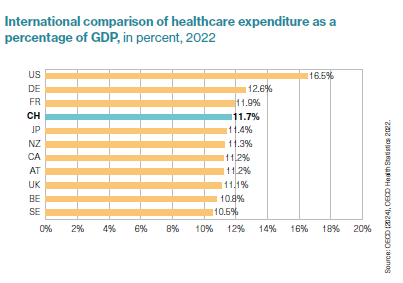
Measured in terms of gross domestic product, healthcare expenditure in Switzerland stands at 11.7 percent (as of 2024). This puts it in a similar range to that of Germany, France, and Japan. The frontrunner is the US with a 16.5 percent share.
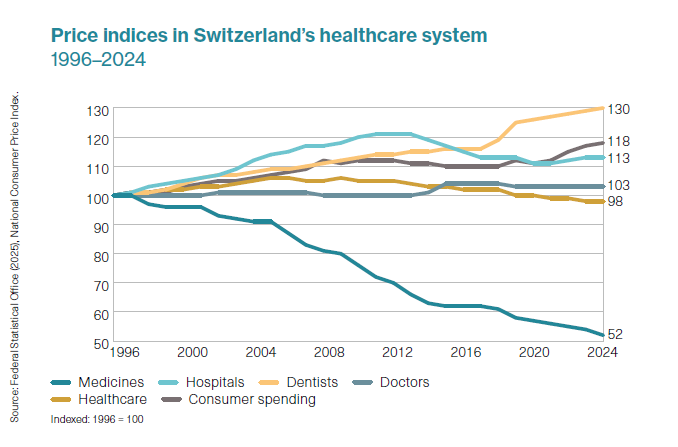
At the same time, the share of medication in healthcare expenditure has remained stable for years at around 12 percent. The drugs price index has fallen by 46 percent since the Swiss Federal Health Insurance Act (HIA) was introduced in 1996. Medication that used to cost CHF 100 in the base year 1996 would cost only CHF 54 today. At the same time, the price index for all other healthcare services has risen.
With its triennial price reviews, the pharmaceutical industry also contributes to the continuous reduction of medication prices. The FOPH reviews the prices of all medications on the Specialties List every three years. This generates recurring annual savings of over CHF 1.5 billion.
Policymakers are making great efforts to curb the growth of healthcare costs. Below is a brief overview of the most important reform projects for the financing of the healthcare system.
Cost-saving measures (packages 1 and 2)
Parliament adopted various measures to curb healthcare costs in Switzerland with its cost containment packages 1 and 2. The measures affecting the pharmaceutical industry included the introduction of differentiated price reviews, confidential pricing models, and provisional reimbursement for medicinal products, as well as cost impact models. The measures introduced in spring 2025 must now be specified in the Health Insurance Ordinance (HIO) and the Health Insurance Benefits Ordinance (HIBO), and should therefore enter into force in early 2027.
Uniform financing of outpatient and inpatient services (EFAS)
In November 2024, the Swiss population approved a proposal for uniform financing in the healthcare sector. This is intended to eliminate disincentives in the existing system. In the future, all healthcare services will be financed equally: from January 1, 2028, health insurers and the cantons will finance outpatient and inpatient services using the same formula. As a result, those who pay the premiums will benefit from the possibility of providing ever more treatments on an outpatient basis and therefore more cost-effectively. From 2032, nursing care will also be financed according to this system.
Outpatient flat rates
From 2026, the current medical tariff Tarmed is to be replaced by Tardoc. This new tariff also provides for the introduction of flat rates for outpatient treatment, such as have already been in place for inpatient care for some years. Medicinal products are also to be included in this system at flat rates. While the introduction of flat rates to increase efficiency and promote a move towards outpatient care is welcome in principle, medicinal products should not be part of it. That’s because while flat rates promote process innovation, they do not adequately reflect product innovation – the primary focus of the pharmaceutical industry.
Society and politics must develop a holistic, sustainable health strategy for our country. In view of demographic trends, the ever-increasing range of medical options and the associated increasing demands, new solutions are needed to ensure the quality, access, and financing of the Swiss healthcare system in the long term. When defining this strategy, the focus must be on the benefit for patients. A coherent strategy with specific objectives and measures can only emerge if all stakeholders in the healthcare sector are involved, seek dialog, and work together constructively. These include the federal government, cantons, health insurers, service providers such as hospitals, doctors, nursing homes, pharmacies, patients, and the pharmaceutical industry. All stakeholders are called upon to break away from silo thinking and develop a holistic view with the overarching goal of ensuring a high-quality and sustainable healthcare system for the future.
 read more
 Read more articles
 Download
 Show all publications
 read more