Newsletter

Subscribe to our newsletter to stay informed.

Newsletter Overlay EN
Salutation
* Mandatory fields
Policy
Directory

Our key topics

Research-based pharmaceutical companies in Switzerland can look back on a long history of success. Their innovative strength has improved the quality of life and prosperity of the population for decades. However, Switzerland as a pharmaceutical location must face new challenges and seize new opportunities: digitalisation, for example, offers enormous potential for medical progress and patient benefit.

Doctor examining an elderly female patient in a hospital room

We are committed to ensuring that all patients in Switzerland receive the best possible medicines and therapies as quickly as possible through their basic insurance. This requires rapid approval by Swissmedic, reimbursement through basic insurance from the date of approval, and sustainable models for rewarding innovation. We guarantee the highest possible quality of these medicines and therapies. And we do our part to ensure that the costs of these therapies remain in reasonable proportion to the benefits for patients, society and the economy.


Researcher at a microscope with test tubes

Pharmacological and technological innovations will improve medicines at a rapid pace. Digitalisation in particular will fundamentally change the development and application of medicines and enable new research approaches. These create great potential for medical progress and patient benefit. In order to implement this, joint efforts by all stakeholders are required.

Medicine vials in pharmaceutical production

Switzerland and the pharmaceutical industry have been on a successful path together for decades: attractive economic conditions have fostered the impressive development of the research-based pharmaceutical industry. At the same time, the pharmaceutical sector, as a pillar of the economy, contributes disproportionately to Switzerland’s prosperity. The pharmaceutical industry will continue to need optimal conditions in the future, and Switzerland needs successful companies. Political stability, legal certainty, open export markets, the availability of skilled labour and an attractive fiscal environment play an essential role in this symbiosis.

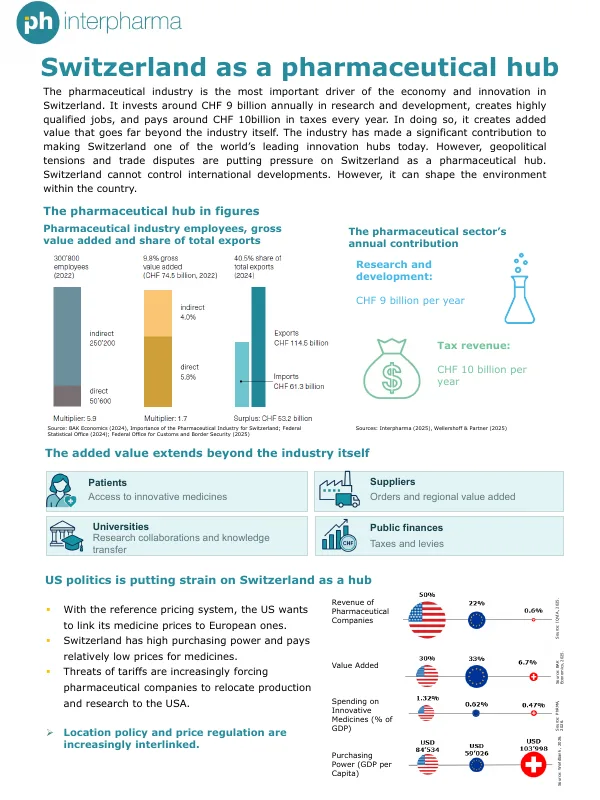
The pharmaceutical industry is the most important driver of the economy and innovation in Switzerland. It invests around CHF 9 billion annually in research and development, creates highly qualified jobs, and pays around CHF 10 billion in taxes every year. In doing so, it creates added value that goes far beyond the industry itself.

The pharmaceutical hub in figures

300’800
employees
(2022)

Indirect:

250’200

Direct:

50’600

Multiplier: 5.9

9.8% of GDP
gross value added
(CHF 74.5 billion, 2022)

Indirect:

4.0%

Direct:

5.8%

Multiplier: 1.7

40.5%
share of total exports
(2024)

Exports:

CHF 114.5 billion

Imports:

CHF 61.3 billion

Surplus: CHF 53.2 billion

Source: BAK Economics (2024), Importance of the Pharmaceutical Industry for Switzerland; Federal Statistical Office (2024); Federal Office for Customs and Border Security (2025)

The pharmaceutical sector’s annual contribution

Microscope icon

Research and development

CHF 9 billion

per year

Icon of a treasure chest with coins and a Swiss cross

Tax revenue

CHF 10 billion 


per year

Source: Interpharma (2025), Wellershoff & Partners (2025)

The added value extends beyond the industry itself

Patients

Access to innovative medicines

Suppliers

Orders and regional value added

Universities

Research collaborations and knowledge transfer

Public finances

Taxes and levies

US politics is putting strain on Switzerland as a hub

Reference pricing system

With the reference pricing system, the US wants to link its medicine prices to European ones.

Purchasing power and prices

Switzerland has high purchasing power and pays relatively low prices for medicines.

Threats of tariffs

Threats of tariffs are increasingly forcing pharmaceutical companies to relocate production and research to the USA.

In summary: Location policy and price regulation are increasingly interlinked.

USA, EU and Switzerland compared

Revenue of pharmaceutical companies

Value added

Spending on innovative medicines

Purchasing power

Revenue of pharmaceutical companies, share in percent

USA

50%

EU

22%

Switzerland

0.6%

Source: IQVIA (2025)

Value added, share in percent

USA

30%

EU

33%

Switzerland

6.7%

Source: BAK Economics (2026)

Spending on innovative medicines (% of GDP)

USA

1.32%

EU

0.62%

Switzerland

0.47%

Source: PhRMA (2026)

Purchasing power (GDP per capita), in USD

USA

USD 84’534

EU

USD 59’026

Switzerland

USD 103’998

Source: Worldbank (2026)

The hub is under pressure

The pharmaceutical industry has made a significant contribution to making Switzerland one of the world’s leading innovation hubs today. However, geopolitical tensions and trade disputes are putting pressure on Switzerland as a pharmaceutical hub.

Swiss share of European investment volume 2016–2021

29%

Swiss share of European investment volume from 2022 on

12%

Europe

+212%

Switzerland

+2.2%

Development of pharmaceutical investment

Global competition between locations

Scenario analysis: effect of US policy on Swiss growth

Nominal value added 2025–2040 in billions (CHF)

BAK Economics study

The Swiss pharmaceutical industry between US onshoring and the MFN pricing regime

Forecast

Reference scenario

Increased production in the USA, but falls offset by growth in other countries; full price reimbursement in Europe and other major markets.

Growth will be maintained (but below the 2015–2025 trend).

Forecast

“Structural break”

Losses in the US market can only be partially offset, while additional price pressure puts downward pressure on growth in the sector.

In the long term, Swiss pharmaceutical growth will fall below its current level.

What’s important now

Switzerland cannot control international developments. However, it can shape the environment within the country.

Life sciences strategy

Consistent improvement of the business environment for companies in Switzerland.

Reviewing overall impact

Assess price regulation projects consistently in terms of their impact on the hub.

Strengthening international networks

Unhindered access to international sales and labor markets.

Laying the groundwork for the future

Creating and maintaining an attractive business environment is not a purely industry-specific issue, it is a key part of Switzerland’s competitiveness.