
Access to innovative medicines: Switzerland continues to stagnate behind Germany
Access to innovative medications in Switzerland has deteriorated overall over the past 10 years. Since 2018, full access through the Specialty List has thus declined from 64 to 50 percentage points. In 2025, Patients in Switzerland continue to have access to only about half as many new, innovative medicines as patients in Germany. In contrast, unequal access through reimbursements in individual cases nearly doubled over the same period, rising from 15% to 27%. New results from the EFPIA Patient W.A.I.T. Indicator, published on May 19, 2026, show that standard access via the Specialties List has declined by around 14 percentage points in Switzerland since 2018.
The EFPIA Patients W.A.I.T. Indicator survey is conducted annually by IQVIA on behalf of EFPIA and compares access to new, innovative medicines in Europe. The study looks at how many of the drugs approved by the EMA over the past four years are actually available in the individual European countries. The 2025 W.A.I.T. Indicator assessed access to 168 innovative medicines approved by the EMA between 2021 and 2024.
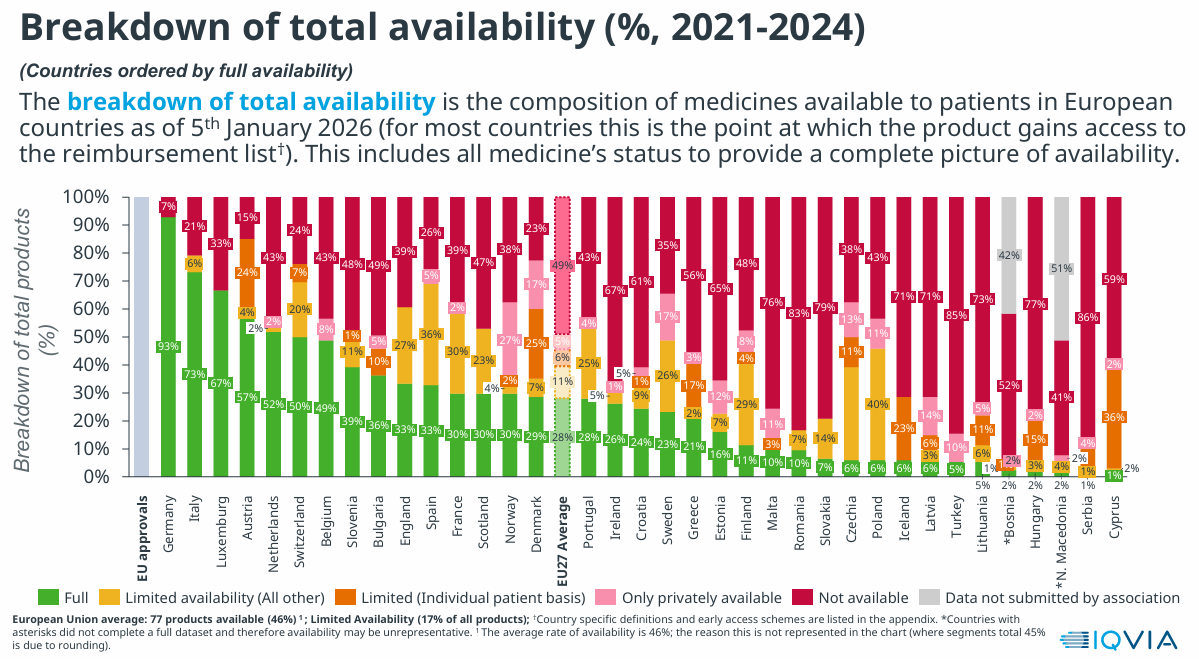
According to the W.A.I.T. Indicator, in 2025 roughly 50 percent of all innovative medicines approved by the EMA between 2021 and 2024 were fully available in Switzerland via the Specialties List. A further 27 percent had limited access via individual case reimbursements under Art. 71a-d of the Health Insurance Ordinance (HIO), while just under a quarter of innovative medications were not available in Switzerland at all. However, individual case reimbursements under Art. 71a-d are only intended for exceptional cases and are therefore not a substitute for equal access via the Specialties List.
With full access to around half of all examined drugs, Switzerland has improved by three percentage points over the previous year. Nevertheless, the situation remains unsatisfactory. Patients in Germany continue to have access to almost twice as many innovative drugs.
A deeper dive shows that access to innovative medicines in Switzerland has declined overall over the past 10 years. Since 2018, full access via the Specialties List has fallen from 64 to 50 percent. By contrast, access via individual case compensation under Art. 71a-d almost doubled from 15 to 27 percent over the same period.
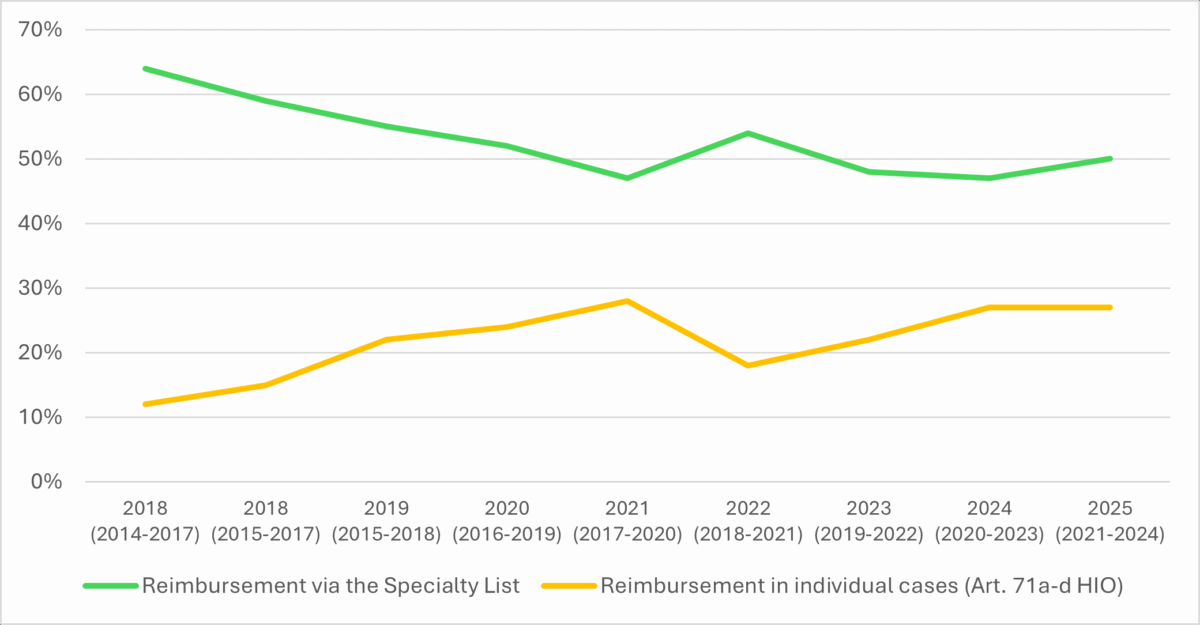
This year’s minimal improvement in full access via the Specialties List is not expected to continue in the coming years. Global conditions have changed fundamentally since the 2021–2024 survey period. The most-favored-nation regime introduced by the US government is fundamentally reshaping the global launch of, and thus access to, innovative drugs. Concrete effects will presumably be seen in the W.A.I.T. Indicator 2026 (survey period 2022–2025).
It is now therefore all the more important to refrain from any political measures that would further restrict access to innovative medicines. Instead, it is essential to modernize the pricing system and ensure access from day zero.
EFPIA Patients W.A.I.T. Indicator 2025 Survey
The EFPIA W.A.I.T. Indicator survey is limited to new active substances. New indications are not taken into account. The salience of the W.A.I.T. Indicator is therefore limited.